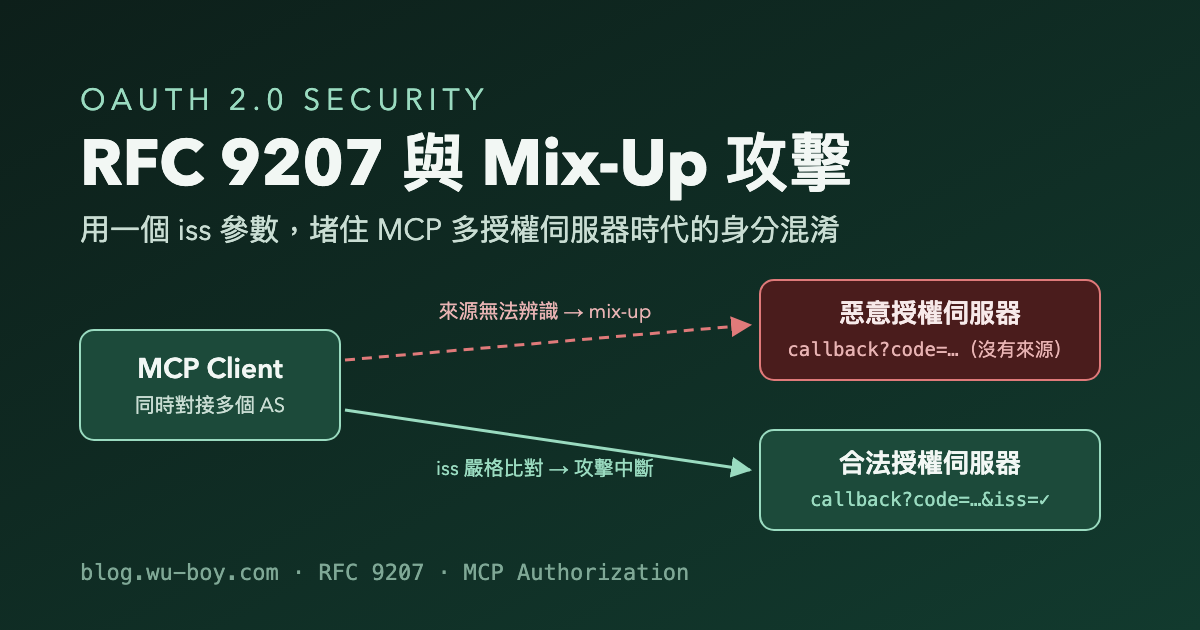
The MCP (Model Context Protocol) Authorization spec rides on standard OAuth 2.1: the MCP Server is the Resource Server, the MCP Client is the OAuth Client, and behind them sits one or more Authorization Servers (AS). The most elegant — and most easily overlooked — property of this design is that a single MCP Client can talk to multiple authorization servers at once. The spec says it in black and white: the authorization_servers field of the Protected Resource Metadata “can define multiple authorization servers,” and “the responsibility for selecting which authorization server to use lies with the MCP client.”
Once “one client, many ASes” becomes the norm, an attack that barely exists in the single-AS world surfaces: the authorization server mix-up attack. This post walks through how the attack works, why the IETF wrote a dedicated RFC — RFC 9207 — just for it, and how to implement it in an OAuth 2.0 authorization server (including an issuer-inconsistency bug the implementation surfaced).
1. The attack: what exactly gets “mixed up”?
First, the precondition — this attack only works when a client trusts two or more ASes. A traditional web app bound to a single AS is completely immune. But multi-AS is the daily reality of MCP: one Claude Code instance might have an MCP server for Gitea, one for Jira, and one for an internal database all connected at once, and the authorization servers behind them are not necessarily the same host.
The root cause: authorization responses are “unsigned”
Before RFC 9207, after a successful Authorization Code Flow the AS redirected the user back to the client like this:
| |
Notice that this response contains no field indicating who issued it. code is an opaque string; state is a random value the client generated itself. When the client receives it, the only way it can decide which token endpoint to redeem the code at is by consulting what it stored in its session: “which AS did I start this flow with?” And that decision can be manipulated by an attacker.
The attack flow
Say there’s a malicious (or compromised) authorization server A-evil, an honest one A-honest, and a victim client that trusts both:
    sequenceDiagram
    participant U as User
    participant C as MCP Client
    participant AE as A-evil (malicious AS)
    participant AH as A-honest (honest AS)

    U->>C: Chooses "log in with A-evil"
    Note over C: session records: this flow = A-evil
    C->>AE: Redirect to A-evil's /authorize
    AE-->>AH: Silently re-redirects the user to A-honest's /authorize<br/>(with the client's A-honest client_id)
    U->>AH: Sees a familiar consent screen, approves
    AH-->>C: 302 callback?code=real_valid_code&state=xyz
    Note over C: session says "this is A-evil's flow"<br/>→ sends A-honest's code to A-evil to redeem
    C->>AE: POST /token (code issued by A-honest)
    Note over AE: A-evil now holds the victim's<br/>authorization code from A-honest
The critical break is the second-to-last step: at the moment the client receives the code, it cannot tell whether the code’s real origin is A-honest or the A-evil it believes it is. So it sends A-honest’s valid authorization code to A-evil’s token endpoint. For a confidential client, this hands the attacker the victim’s authorization code from A-honest (which can be further exchanged for an access token) on a silver platter.
This is not theoretical. The IETF OAuth working group standardized the iss solution as RFC 9207 in 2022 precisely because this class of attack is practically feasible in multi-AS scenarios.
2. Why does RFC 9207 exist?
You might ask: don’t we already have state and PKCE? Why a new RFC? Because they defend against different things:
| Mechanism | What it defends | Effective against mix-up? |
|---|---|---|
state | CSRF — binding an attacker’s authorization response to the victim’s session | ❌ The attacker uses the victim’s own legitimate flow |
| PKCE | Authorization code interception / injection | ❌ The code wasn’t intercepted; the client sent it to the wrong place |
RFC 9207 iss | Origin confusion of the authorization response | ✅ Lets the client verify which AS actually issued the code |
state solves CSRF and PKCE solves code interception, but both assume “the client knows which AS issued this code.” The mix-up attack targets exactly that assumption — it makes the client misjudge the origin. That’s a hole neither state nor PKCE can structurally cover, so a new mechanism is needed: make the authorization response sign itself.
RFC 9207’s solution is minimal: add an iss parameter to every authorization response (success and error alike), whose value is the AS’s issuer identifier, and which MUST be byte-for-byte identical to the issuer field the AS publishes in its metadata. When the client receives a response, it does a strict string comparison of iss against “the issuer of the AS I expected for this flow,” and discards anything that doesn’t match.
Back to the attack: at step five the client’s session expects iss=https://evil.example, but A-honest returns iss=https://honest.example → comparison fails → the code is discarded and never reaches A-evil’s token endpoint. The attack is severed before any damage is done.
And the attacker can’t forge this value: iss is added by the AS on its own server side, and A-evil never touches A-honest’s redirect; the baseline the client compares against (the expected issuer) is also in the client’s own hands, not something the response gets to assert.
How this relates to the MCP security model
The MCP Authorization spec doesn’t name RFC 9207 directly, but the entire skeleton of the document pushes the mix-up attack squarely into your path:
- Multi-AS is a built-in assumption. The spec explicitly allows one Protected Resource to map to multiple
authorization_servers, and hands the “pick one” responsibility to the client. That’s the exact breeding ground for mix-up. - It already mandates RFC 8707 Resource Indicators and audience validation. The spec states in no uncertain terms that the client “MUST include the
resourceparameter in authorization and token requests” and the MCP Server “MUST validate that access tokens were issued specifically for them as the intended audience.” That defends against “tokens misused across services” (confused deputy / token misredirection). RFC 9207 is the other segment of the same line of defense — it ensures the origin of the authorization code is aligned before it’s ever exchanged for a token. The two are complementary: one governs where a token goes, the other governs where a code came from. - It requires AS metadata discovery (RFC 8414 / OIDC Discovery). RFC 9207’s
issvalue must equal the metadataissuer— the very field the spec already requires you to publish is exactly the trusted baseline the client uses to compareissagainst.
In other words, when you’re writing an OAuth server for the MCP ecosystem, RFC 9207 isn’t a nice-to-have; it fills the structural origin-verification gap in the multi-AS architecture MCP has already laid down. The spec’s high bar for the resource parameter and audience validation hints at the same mindset: in an environment where multiple parties don’t trust each other, every message must prove its own origin and destination.
The official client already expects this value
This isn’t just theory — it’s already on the official MCP roadmap. In the beta SDK announcement for the 2026-07-28 spec release candidate, the MCP team states outright that the authorization hardening in this beta (SEP-2468) includes "iss validation per RFC 9207", and that all four official SDKs (Python, TypeScript, Go, C#) implement the release candidate’s core protocol changes. Take the official MCP Go SDK as an example: its AuthorizationResult struct now contains three fields — Code, State, and Iss:
| |
What matters more is how it uses that value. The SDK’s validateIssuerResponse spells out the RFC 9207 comparison rules exactly — and cross-checks the metadata support flag at the same time:
| |
And where does that third argument, issParameterSupported, come from? The SDK parses it out of your authorization server metadata. The SDK’s AuthServerMeta (mapping the RFC 8414 / OIDC discovery document) gained the same field:
| |
That closes the loop end to end: the flag you advertise at /.well-known on the server → the SDK parses it into AuthServerMeta → that bool feeds into validateIssuerResponse → it decides whether to enforce iss validation.
This snippet directly confirms two things from earlier. First, iss != expectedIssuer is that “strict string comparison” — a single byte off (say, a trailing slash) aborts the entire authorization flow, which is exactly why Section 3 hammers on the issuer being byte-for-byte aligned. Second, it reads issParameterSupported (i.e. the authorization_response_iss_parameter_supported you advertise in metadata): AS says supported but sent none → error; AS says unsupported but sent one → also error. In other words, the moment your metadata flag and your actual behavior disagree, the official client rejects you. That’s why “advertise support” on the server side is never optional and must match real behavior exactly.
For a server-side implementer, this yields a very concrete conclusion: the iss you emit will actually be compared byte-for-byte — it’s not decorative. Any inconsistency in your issuer derivation (the next section shows a live example) and the official MCP client will be the first to bounce you.
3. The solution: how to implement it
Take an OAuth 2.0 authorization server as an example — one that supports Authorization Code Flow (with PKCE) and already implements RFC 8707 Resource Indicators, exactly the kind of AS an MCP scenario would use. Making it RFC 9207-compliant touches less than you’d expect, because all authorization responses already funnel through two functions.
3-1. Add iss to every authorization response
Every success redirect goes through issueCodeAndRedirect, and every error redirect through redirectWithError. So the core change is two lines of q.Set("iss", …):
| |
Error responses are the same — and this point matters especially. RFC 9207 requires iss even on error responses, otherwise an attacker could simply switch to the “error response” variant to bypass the protection. As for cases that fail before the redirect_uri has been proven legitimate (e.g. a wrong client_id), the correct behavior is to render a local error page and not redirect at all, so no iss is needed — no redirect means no origin to confuse.
3-2. Advertise support in metadata
Next, add authorization_response_iss_parameter_supported: true to both discovery documents (/.well-known/openid-configuration and /.well-known/oauth-authorization-server). This step is not optional: RFC 9207 requires “if you do it, advertise it,” because the client uses this flag to decide whether to enable strict iss validation.
3-3. The pitfall worth telling: the three faces of the issuer
This is the most valuable part of the whole implementation. After the feature was written and the tests were green, I ran a heavy multi-agent code review, which unearthed a pre-existing bug that this change amplified:
The string “the issuer” was originally derived independently in at least three places — all strings.TrimRight(cfg.BaseURL, "/") — one for the discovery document, one for the ID token, one for token exchange. Worse, three other places (the access-token JWT iss claim, /oauth/tokeninfo, and /oauth/introspect) used the raw BaseURL without stripping the trailing slash.
Harmless most of the time, but the moment an operator sets BASE_URL to a trailing-slash https://auth.example.com/, a single token exchange emits:
- discovery
issuerand the new redirectiss:https://auth.example.com(slash stripped) - the ID token’s
iss:https://auth.example.com(slash stripped) - the access token’s
iss:https://auth.example.com/(slash NOT stripped)
A single byte of difference is enough for any resource server doing RFC 9068 access-token issuer validation to reject every token. And RFC 9207 specifically requires iss to be byte-for-byte identical to the metadata issuer — this “derive-it-in-many-places” style is itself a ticking protocol-break time bomb.
The fix is to collapse the derivation into a single source of truth, placed in config:
| |
Then point all six emission sites at cfg.Issuer(). This review lesson deserves its own note: when “multiple copies of a value must always be equal” becomes a precondition for protocol correctness, it shouldn’t have multiple copies at all. Collapsing it into one method and relying on the type system plus a unified call site to guarantee consistency is far more reliable than chasing six places with a single test.
Upgrade note: if your
BASE_URLhas a trailing slash, this fix changes the JWTissfromhttps://host/tohttps://host(aligned with discovery). Flush your token cache on upgrade.
3-4. Verification: three e2e tests + metadata assertions
I pinned the behavioral side of RFC 9207 with three end-to-end tests:
- Happy path: user approves → 302 with
code,state,iss, whereissis byte-for-byte identical to the live discoveryissuer(including a trailing-slashBASE_URLvariant). - Error path: user denies → 302 with
error=access_denied,state, and the sameiss. - No-redirect path: unregistered
redirect_uri→ local error page, emptyLocation(noissleak).
Plus assertions that both discovery documents return authorization_response_iss_parameter_supported: true. The design choice in the first test — comparing the redirect’s iss against the actually served discovery issuer — is deliberate: it also guards the “multiple faces must be equal” invariant from 3-3.
Wrapping up
Mix-up attacks aren’t a new trick, but they’ve long been hidden behind the single-AS assumption. MCP makes “one client, many authorization servers” an everyday reality — which is exactly what wakes this dormant hole up. RFC 9207’s solution is elegant to the point of being plain: give every authorization response an unforgeable iss aligned with the metadata, turning the client’s judgment of origin from “guess” into “verify.”
If you’re writing or choosing an OAuth server for the MCP ecosystem, my advice is to view it alongside the RFC 8707 audience validation the MCP spec already mandates:
- RFC 8707 + audience validation governs the token’s destination — this token can only be accepted by the resource server it’s meant for.
- RFC 9207
issgoverns the code’s origin — this code really was issued by the AS I expected.
Both lines of defense are indispensable, and both point to the same discipline in a multi-party zero-trust environment: every message must prove where it came from and where it’s going. I hope this walkthrough — and that issuer-consistency pitfall — saves you a detour in your own implementation.