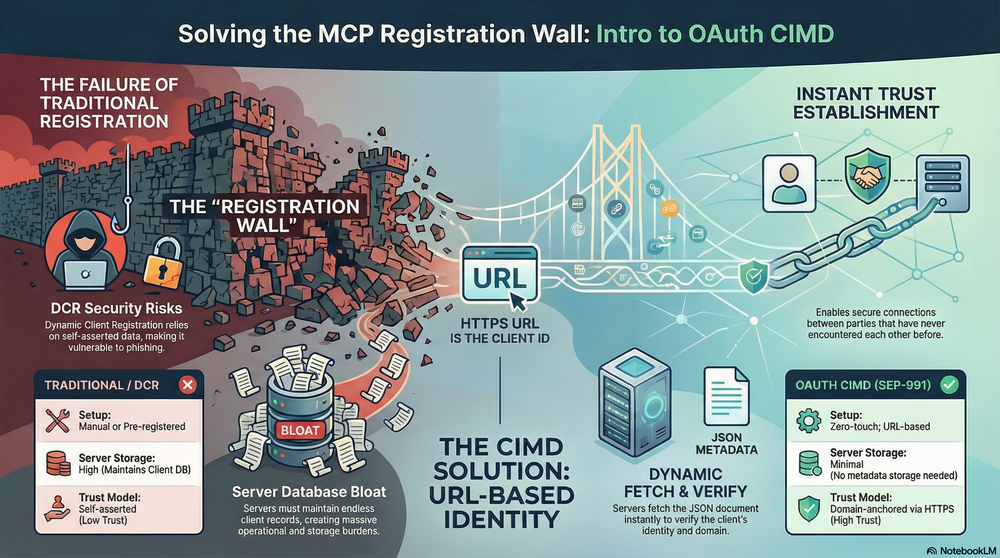
In 2025, I introduced MCP (Model Context Protocol) at the iThome Taiwan Cloud Summit. At that time, I mentioned that the official team has been continuously revising the authentication protocol to address complex authentication flows. The previous design involved DCR (Dynamic Client Registration), so as expected, on 2025/11/25, a new Authorization mechanism was released. This authentication mechanism is called “Client ID Metadata Documents, abbreviated as CIMD”.
When installing a Model Context Protocol (MCP) server, the most challenging part is often not the protocol itself, but how to establish trust between the client and server. If you’ve ever tried to connect an MCP client to an MCP server it has never encountered before, you’ve probably run into what’s known as the “registration wall”.
Pre-registering with every possible authorization server is simply not scalable, and while Dynamic Client Registration (DCR) helps, it lacks reliable mechanisms to verify client identity, making it vulnerable to phishing attacks. Beyond security concerns, DCR also creates operational overhead by generating an ever-growing number of duplicate client identities that need to be managed.
[Read More]